How to Write Content That AI Assistants Quote
The structure, formatting and writing habits that make a page easy for ChatGPT, Gemini and Perplexity to extract, quote and cite, with a before and after rewrite.
Read the guideWhat Google's guidance and spam policies say about AI written content, a clear table of what is allowed and what is risky, and the editing workflow we use before anything is published.
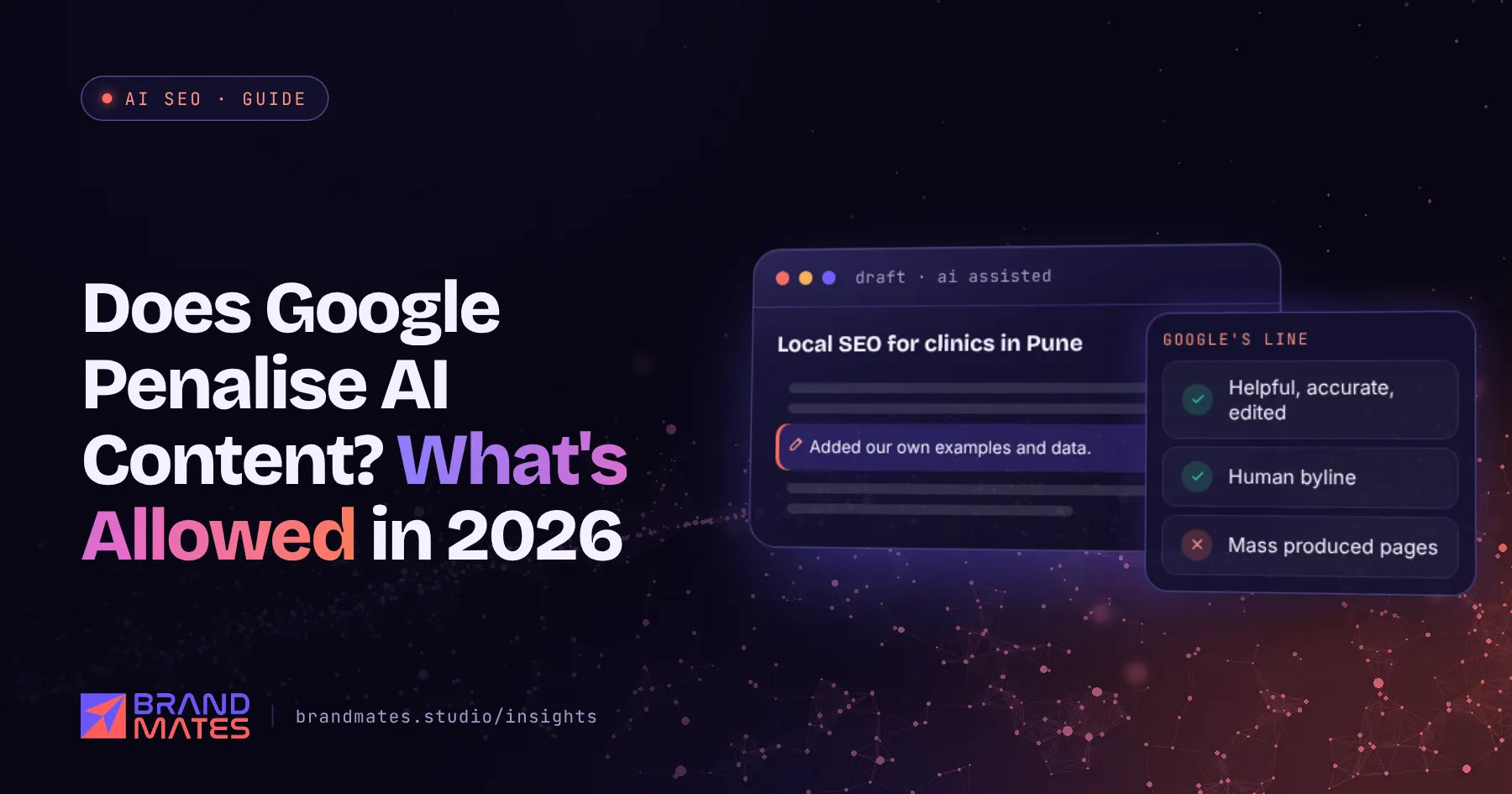
Almost every business that publishes content now uses AI somewhere in the process, for research, outlines, first drafts or product descriptions. The question we hear most often is whether that puts the site at risk.
So, does Google penalise AI content? Not for being written with AI. Google penalises content that is low value and produced at scale to manipulate rankings, however it was made. This guide explains what Google's guidance and spam policies actually say, what is allowed and what is risky, and the editing workflow we use before any AI assisted content goes live. It is part of our complete AI SEO guide.
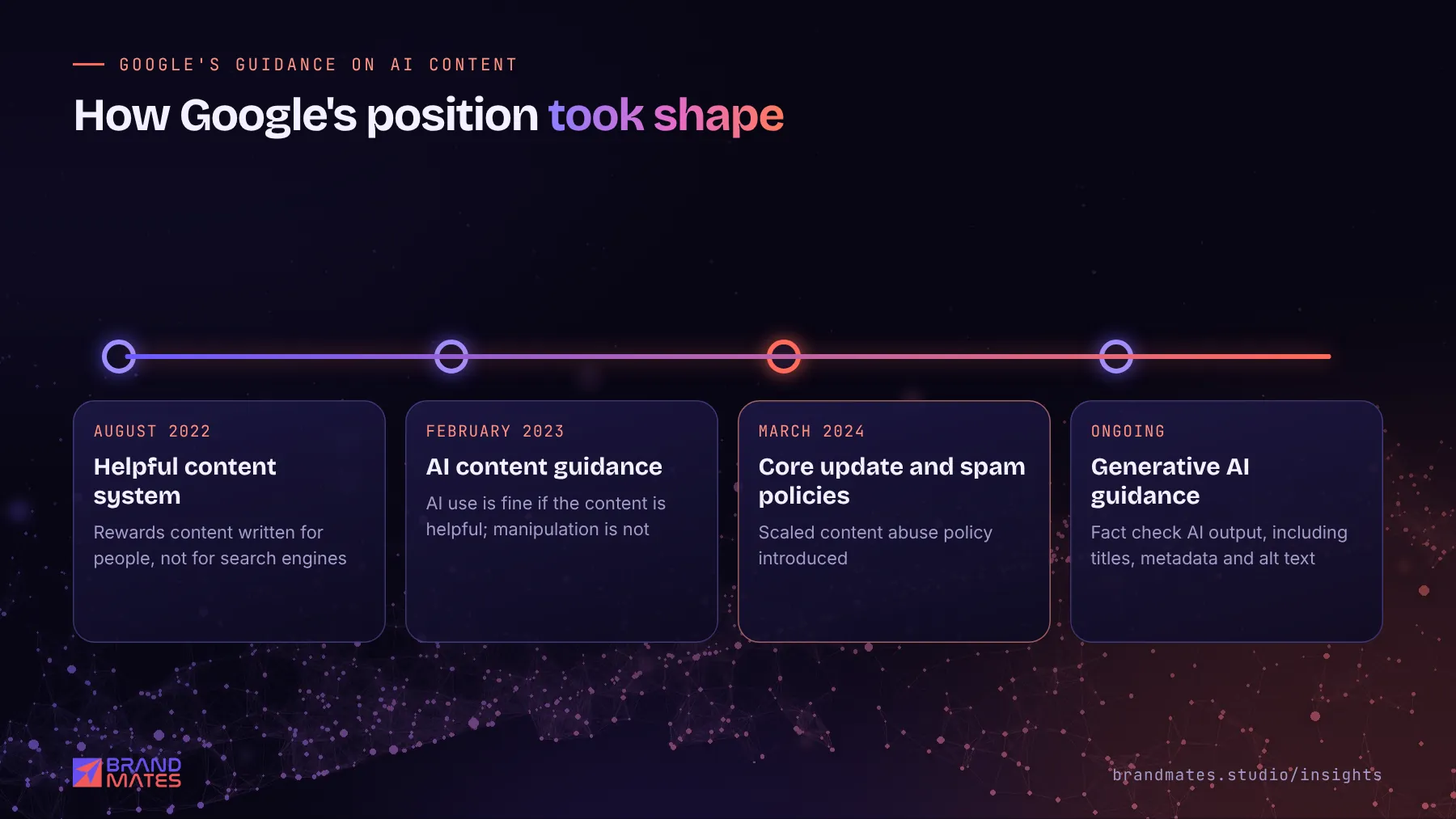
In February 2023, Google published its guidance on AI generated content. The key points:
In other words, the tool is not the problem. The intent and the result are.
| Date | Guidance or update | What it means for AI content |
|---|---|---|
| August 2022 | Helpful content system launched | Rewards content written for people rather than for search engines |
| February 2023 | Guidance on AI generated content | AI use is fine if the content is helpful; manipulation is not |
| March 2024 | Core update and new spam policies | Helpful content signals moved into core ranking; scaled content abuse policy introduced |
| Ongoing | Guidance on using generative AI content | Fact check AI output, including metadata, and follow Merchant Center rules for products |
The policy that matters most is scaled content abuse. Google defines it as generating many pages for the primary purpose of manipulating search rankings and not helping users, typically large amounts of unoriginal content that provides little to no value, "no matter how it's created".
Google's examples include using generative AI tools to produce many pages without adding value for users, scraping content and rewriting it through automated transformations such as synonymising or translating, and stitching together content from other pages without adding value.
Google's guidance on generative AI content also asks site owners to manually fact check AI output before publishing. That review should cover title elements, meta descriptions, structured data and image alt text, not only the body copy, because all of these can appear in search results.
| Generally fine | Risky or against policy |
|---|---|
| Using AI to research a topic and build an outline | Publishing hundreds of AI articles on every keyword with no review |
| AI assisted first drafts edited and checked by a subject expert | Location pages that only swap the city name |
| Summarising your own data, case studies or interviews | Rewriting competitors' or scraped content through AI |
| Product description drafts checked against real specifications | Auto translated pages published without review |
| Drafting meta descriptions and alt text that a person reviews | Mass publishing AI content on an expired or purchased domain |
| Turning a recorded expert interview into an article | AI generated reviews or testimonials |
The pattern is consistent. AI as a tool inside a careful editorial process is fine. AI as a replacement for expertise, review and original value is where sites get into trouble.
Even content that stays within the rules can fail to rank. A model trained on what is already published will, by default, produce something similar to what is already published. If ten pages already say the same thing, an eleventh adds nothing, for Google or for its readers.
The same applies to AI search. Assistants such as ChatGPT and Perplexity cite pages that contain something specific: a real price range, a measured result, an original example, a clear definition from someone with experience. Generic text gives them nothing new to quote. Our guide on how to write content AI assistants quote explains what they look for, and AEO vs GEO explains how being quoted and being recommended differ.
What makes AI assisted content worth ranking is what only you can add:
Want to know if ChatGPT recommends you?We test your buyer questions across ChatGPT, Gemini, Perplexity and AI Overviews, then show you exactly what to fix.
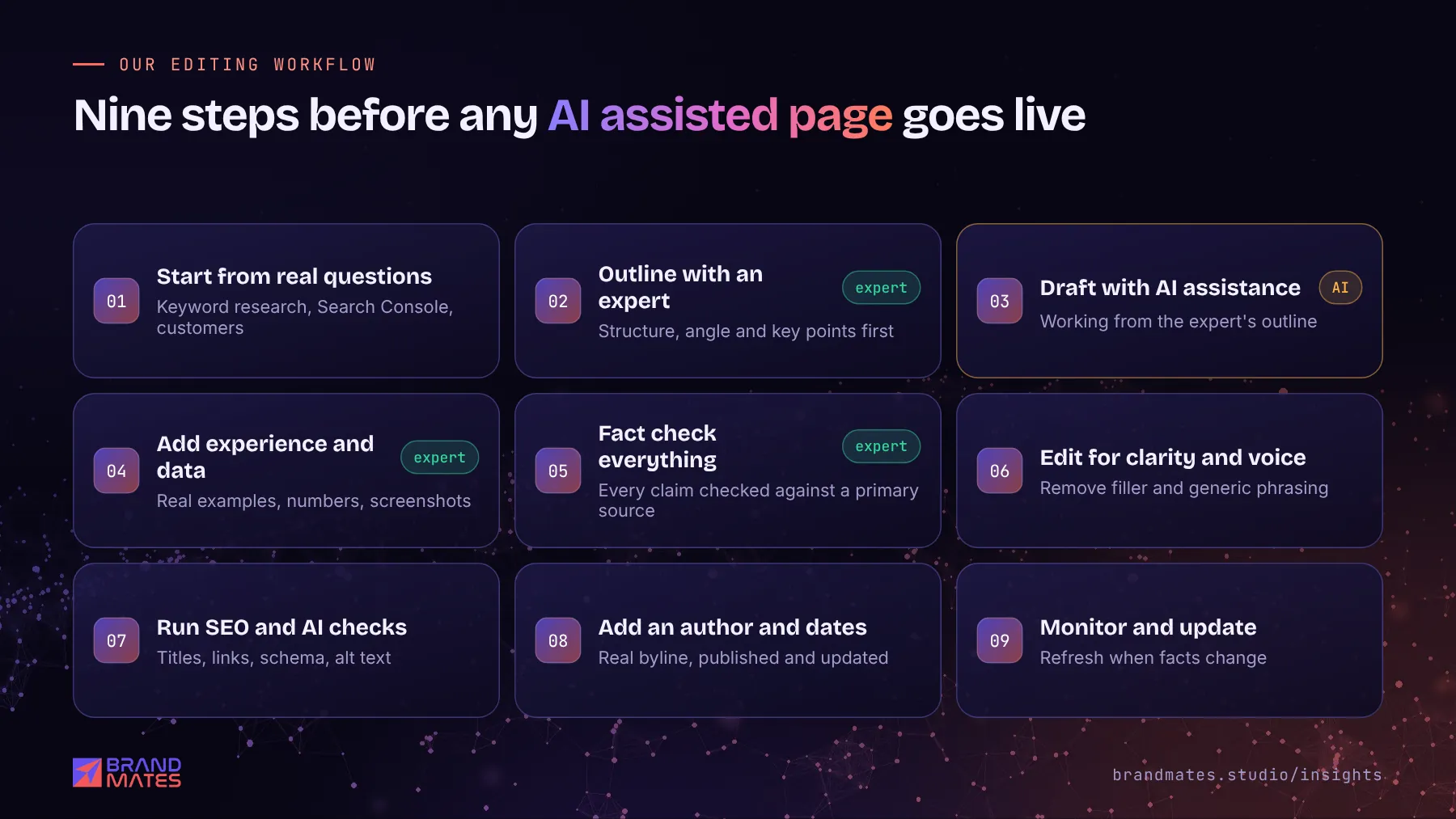
This is the process we follow before any AI assisted article or page is published:
If you see these signs, consolidate overlapping pages into fewer, stronger ones, add genuine experience and data to pages worth keeping, and remove or noindex pages that add nothing. Our SEO audit checklist helps you find them.
Google says that explaining how content was created can be useful to readers in some situations, particularly where automation played a large role. For most business content, the more important step is a clear human byline: a named person who is accountable for the accuracy of the page.
There are stricter rules for ecommerce. Google Merchant Center requires AI generated images to carry IPTC metadata identifying them as AI generated, and AI generated product data such as titles and descriptions must be labelled as AI generated in the feed.
Quality content that answers real buyer questions still wins. On a Shopify smart TV store, we rewrote product and collection copy around the questions buyers ask, added product and FAQ schema and fixed page structure. Comparing August 2026 with February 2026 in Google Analytics 4, organic search users grew from 172 to 3,286 a month. See the Shopify SEO case study.
Our content marketing services combine expert input, careful editing and full SEO and AI checks, so every page is built to rank in Google and be quoted by AI assistants. Request a free AI visibility audit and we will review your existing content against Google's guidance.
Google has not said that it ranks pages based on detecting AI. Its guidance and spam policies focus on the quality, originality and purpose of content rather than the tool used to write it. Unhelpful content produced at scale is the risk, however it was made.
It is safe if a knowledgeable person reviews it, fact checks every claim, adds real experience and makes sure it is useful. Publishing unedited ChatGPT output, especially in bulk, risks inaccurate content and may fall under Google's scaled content abuse policy.
Yes. Google's guidance says appropriate use of AI is not against its guidelines. AI assisted pages rank when they are accurate, original and more useful than the alternatives, which usually means adding expertise and data that a model cannot supply.
Google does not require a label on ordinary web pages, though it notes that explaining how content was created can help readers in some cases. Merchant Center does require AI generated product images and product data to be identified. A clear human byline matters for every page.
There is no percentage limit. The test is whether the published page is accurate, original and helpful to the reader. If AI did most of the work and nobody with expertise added anything or checked it, that is too much.
The structure, formatting and writing habits that make a page easy for ChatGPT, Gemini and Perplexity to extract, quote and cite, with a before and after rewrite.
Read the guide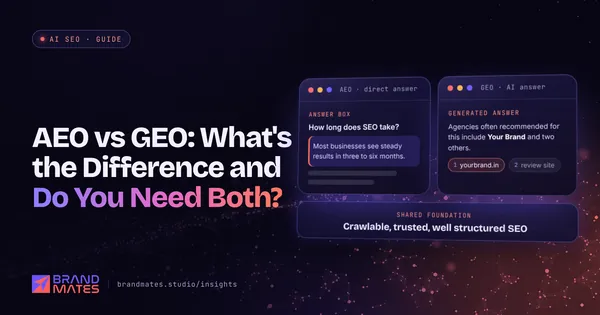
Answer Engine Optimization and Generative Engine Optimization explained in plain language, how they differ, how they overlap with SEO and how to run them together.
Read the guide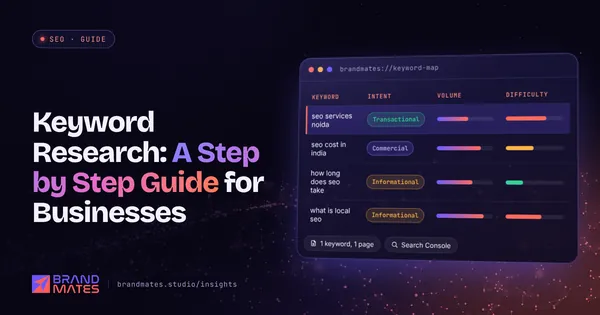
How to find the searches your buyers actually make, sort them by intent, map each one to the right page and decide what to target first.
Read the guideTell us where your brand needs to go. We'll come back with a free audit, a plan and a realistic timeline, usually within two working days.