How to Write Content That AI Assistants Quote
The structure, formatting and writing habits that make a page easy for ChatGPT, Gemini and Perplexity to extract, quote and cite, with a before and after rewrite.
Read the guideWhy AI assistants recommend brands they can recognise and trust, and how to build the consistent descriptions, schema, mentions and reviews that make your brand an entity.
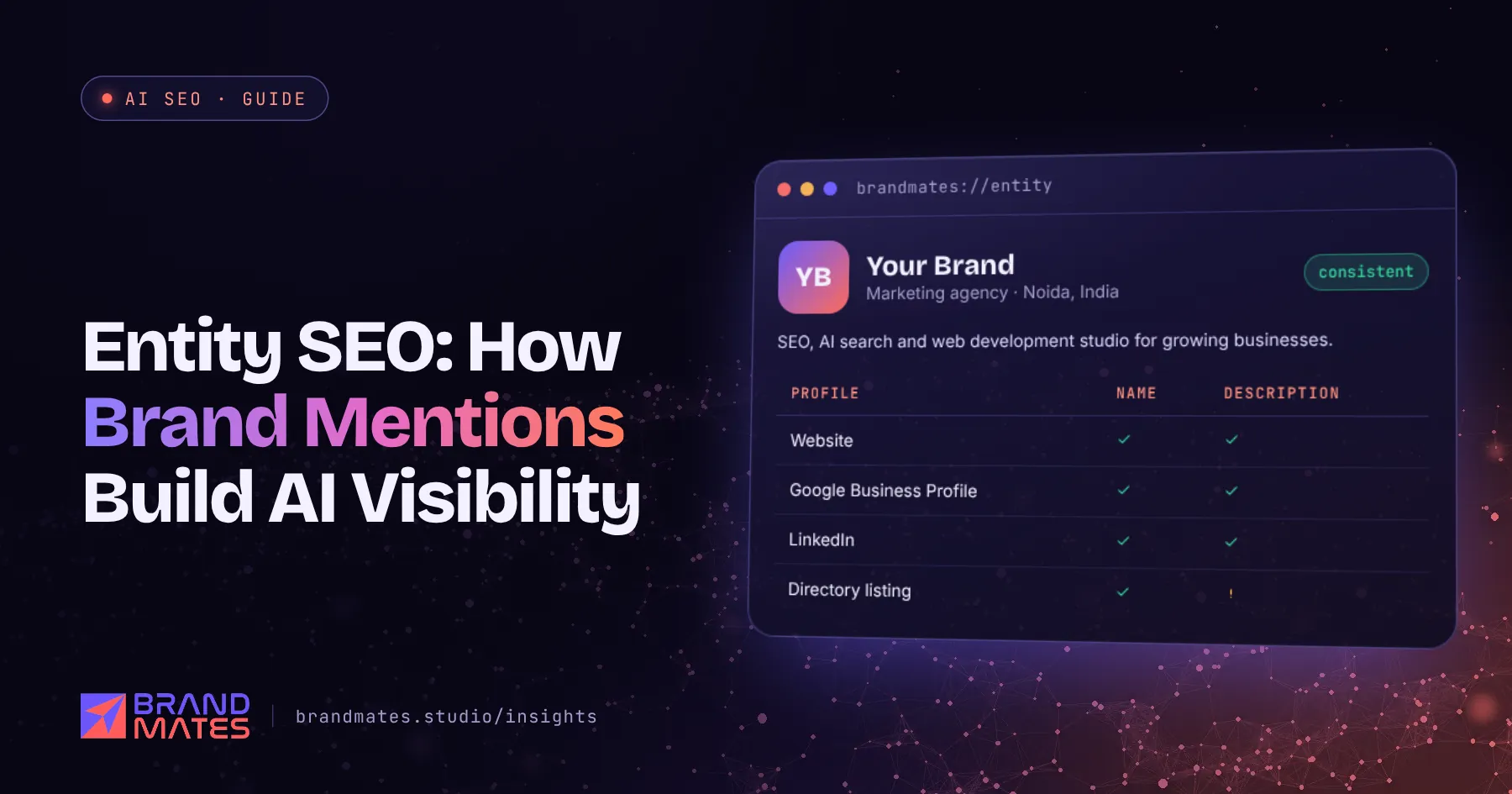
Ask ChatGPT to recommend an agency, a manufacturer or a clinic in your city, and it will name a few businesses with confidence. It does not name them because they have the most keywords on their websites. It names them because it recognises them: it has read about them, consistently, in enough places to be sure who they are and what they do.
That recognition is what entity SEO builds. This guide explains what an entity is, why AI assistants rely on entity signals when they recommend brands, and the practical steps to make your business clearly recognisable across the web. It is part of our complete AI SEO guide.
An entity is a distinct, identifiable thing: a business, a person, a place, a product or a concept. "BrandMates Studio", "Noida" and "drone light show" are all entities. Each one has attributes, such as a location, a founder or a category, and relationships with other entities.
Google has organised information this way since it introduced the Knowledge Graph in 2012, with the idea of understanding "things, not strings". Instead of matching words on a page, it tries to understand which real world thing a page is about.
Large language models work in a related way. They form associations between a brand and the topics, places and qualities it is mentioned alongside. When those associations are strong and consistent, the model can describe the brand accurately and is more willing to recommend it.
When an assistant is asked "which companies offer drone light shows for weddings in India?", it needs to answer with confidence. It is more likely to name a business when:
Contradictions work against you. If one directory lists an old address, another a different phone number and your LinkedIn page describes services you stopped offering, an assistant has less reason to trust any single version.
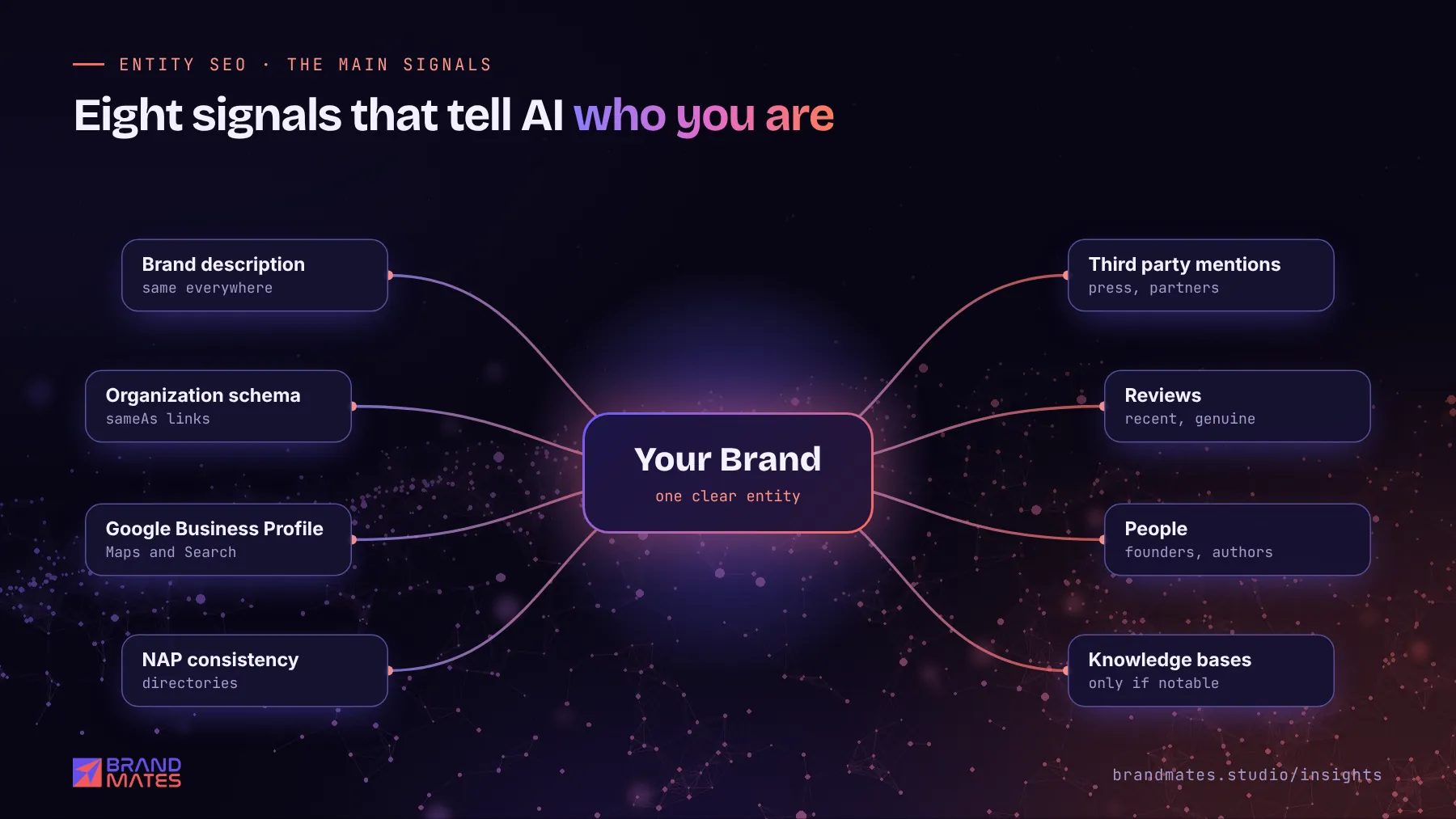
| Signal | Where it lives | What to check |
|---|---|---|
| Brand description | Website, about page, every profile | The same one sentence description everywhere |
| Organization schema | Homepage code | Name, logo, URL, address, contact details and sameAs links |
| Google Business Profile | Google Maps and Search | Correct name, category, services, hours and photos |
| NAP consistency | Directories and citations | Identical name, address and phone number on every listing |
| Third party mentions | Industry sites, press, partner websites | Accurate descriptions that connect your brand to your services |
| Reviews | Google, industry platforms, marketplaces | Recent, genuine reviews with responses |
| People | Author pages, LinkedIn, speaker profiles | Founders and experts clearly connected to the brand |
| Knowledge bases | Wikidata, Wikipedia | Only where the business meets their notability rules |
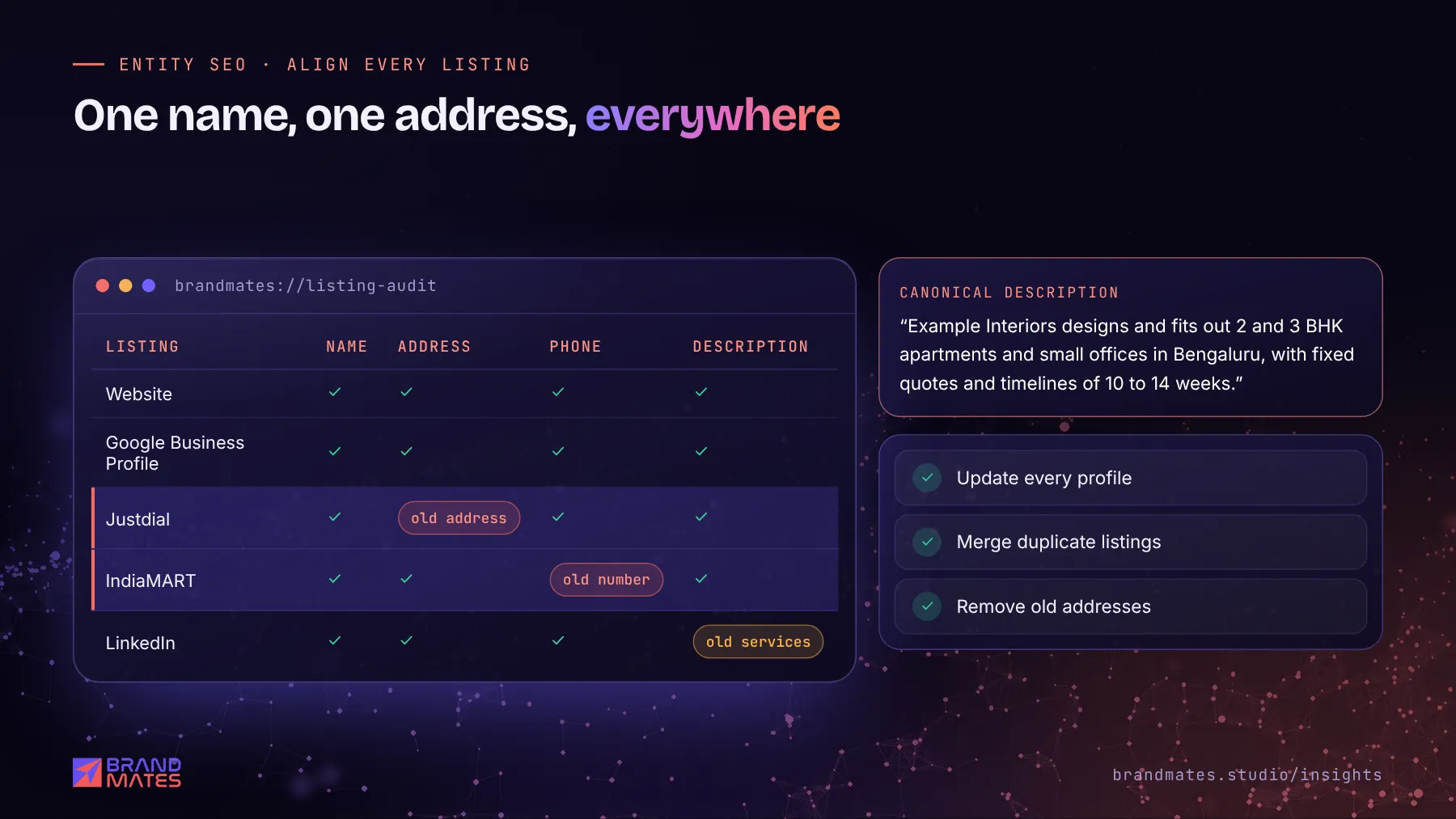
Write a one sentence description and a short paragraph that state what you do, for whom and where. For example: "Example Interiors designs and fits out 2 and 3 BHK apartments and small offices in Bengaluru, with fixed quotes and timelines of 10 to 14 weeks." Use the same wording, or very close to it, on your website, Google Business Profile, LinkedIn, directories and press materials.
Include the founding year, founders, location, team size, services, industries served and notable results. This is often the page an assistant reads to learn about you, so write it in plain, factual language. Our guide on how to write content AI assistants quote explains the style.
Organization schema tells machines who you are in a standard format. The sameAs property links your website to your official profiles, which helps connect them as one entity.
{
  "@context": "https://schema.org",
  "@type": "Organization",
  "name": "Example Interiors",
  "url": "https://www.example.com",
  "logo": "https://www.example.com/logo.png",
  "description": "Example Interiors designs and fits out homes and offices in Bengaluru.",
  "foundingDate": "2018",
  "address": {
    "@type": "PostalAddress",
    "addressLocality": "Bengaluru",
    "addressRegion": "Karnataka",
    "addressCountry": "IN"
  },
  "sameAs": [
    "https://www.linkedin.com/company/example-interiors",
    "https://www.instagram.com/exampleinteriors",
    "https://www.youtube.com/@exampleinteriors"
  ]
}
Keep the details identical to what appears on the page. Our guide to schema markup for AI search covers the other types worth adding.
List every place your business appears: Google Business Profile, Bing Places, Justdial, IndiaMART, Clutch, industry directories, marketplaces and social profiles. Update each one so the name, address, phone number, website, hours and description match. Remove or correct duplicates and old addresses. For location based businesses, this is also a core part of local SEO.
Guest articles, expert quotes in publications, partner and supplier pages, industry associations, event listings and case studies published by clients all connect your brand with your topic on independent sites. Links from those pages help traditional rankings, and the mentions themselves add to how your brand is described across the web. Our link building guide explains how to earn them safely.
Ask every satisfied customer for a review, make it easy with a direct link and reply to every review, positive or negative. Never offer discounts, gifts or payment in exchange for reviews, and never ask only happy customers. Google's policies prohibit incentivised reviews and selective review requests, and fake reviews damage trust with people and machines alike.
Give authors bylines and short bios, link team members' LinkedIn profiles to the company page and list founders on the about page. People are entities too, and recognised experts strengthen the brand they work for.
A Wikipedia article requires significant coverage in independent, reliable sources, and writing about your own company is a conflict of interest under Wikipedia's rules. Most small and medium businesses do not qualify, and paying someone to create an article usually ends with it being deleted. Wikidata is more open, but items still need serious, publicly available references. Treat both as a result of real coverage, not a shortcut to it.
Want to know if ChatGPT recommends you?We test your buyer questions across ChatGPT, Gemini, Perplexity and AI Overviews, then show you exactly what to fix.
Ask ChatGPT, Gemini and Perplexity questions such as:
Compare the answers with your canonical description. Wrong services, old addresses or confusion with a similarly named business all point to sources you need to fix. Our guide on how to check if ChatGPT recommends your brand has a full prompt list and tracking sheet.
Inconsistent names. "BrandMates", "Brand Mates" and "BrandMates Studio Pvt Ltd" used at random make it harder to connect mentions to one entity. Pick one primary name.
Old addresses and numbers left online. A move or a new phone number needs updating everywhere, not only on your website.
Vague descriptions. "We provide innovative solutions" says nothing an assistant can use.
Buying reviews or Wikipedia pages. Both break platform rules and tend to be removed.
Ignoring mentions without links. Even an unlinked mention on a respected site adds to how your brand is described.
For a drone light show company, we rewrote service pages by occasion and city, added structured data and earned more than 45 quality backlinks from relevant sites, so the brand was described clearly on independent sources as well as its own website. Over six months organic traffic grew 320%, and in one recent month AI assistants sent 23 visitors to the site, from zero before the work began. See the drone light show SEO case study.
Entity work is part of every engagement in our AI SEO services, alongside technical fixes, content and authority building. Request a free AI visibility audit and we will show you how AI assistants currently describe your brand and what to fix.
Entity SEO is the work of making search engines and AI assistants clearly recognise your business as a specific, trustworthy thing. It relies on a consistent description, structured data, accurate listings, independent mentions and reviews across the web.
No. Most businesses that AI assistants recommend do not have a Wikipedia article. Consistent listings, strong reviews, structured data and mentions on respected industry sites matter far more for most small and medium businesses.
Local businesses usually get a panel through a verified Google Business Profile. For other brands, Google creates knowledge panels automatically when it has enough consistent information. If one appears, you can claim it through Google to suggest corrections.
The sameAs property links your website to your official profiles in a standard format, which helps machines connect them as one entity. It is most effective when the information on those profiles matches your site.
Schema and listing fixes take effect as pages are recrawled, usually within weeks. A strong, widely recognised entity builds over months, because it depends on mentions, reviews and coverage that accumulate over time.
The structure, formatting and writing habits that make a page easy for ChatGPT, Gemini and Perplexity to extract, quote and cite, with a before and after rewrite.
Read the guide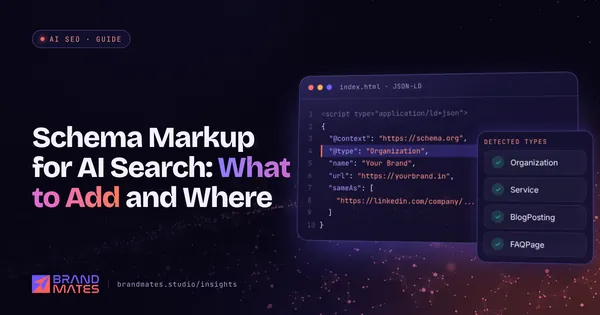
A page by page guide to the structured data that helps search engines and AI assistants understand your business, with a JSON-LD example, common mistakes and how to test it.
Read the guide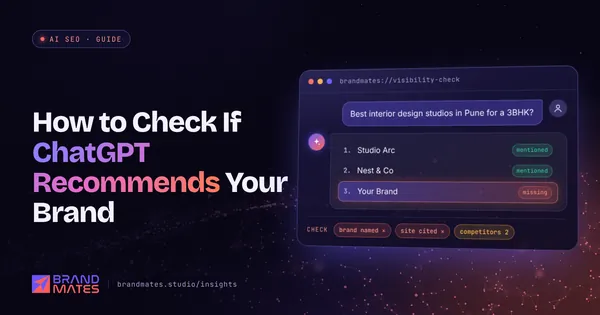
A simple, repeatable method to see whether ChatGPT, Gemini, Perplexity and Google AI answers name your business, which pages they cite and what to fix when they do not.
Read the guideTell us where your brand needs to go. We'll come back with a free audit, a plan and a realistic timeline, usually within two working days.