How to Write Content That AI Assistants Quote
The structure, formatting and writing habits that make a page easy for ChatGPT, Gemini and Perplexity to extract, quote and cite, with a before and after rewrite.
Read the guideHow Perplexity retrieves and cites sources, the two crawlers you need to allow, and a step by step plan to get your brand named and linked in its answers.
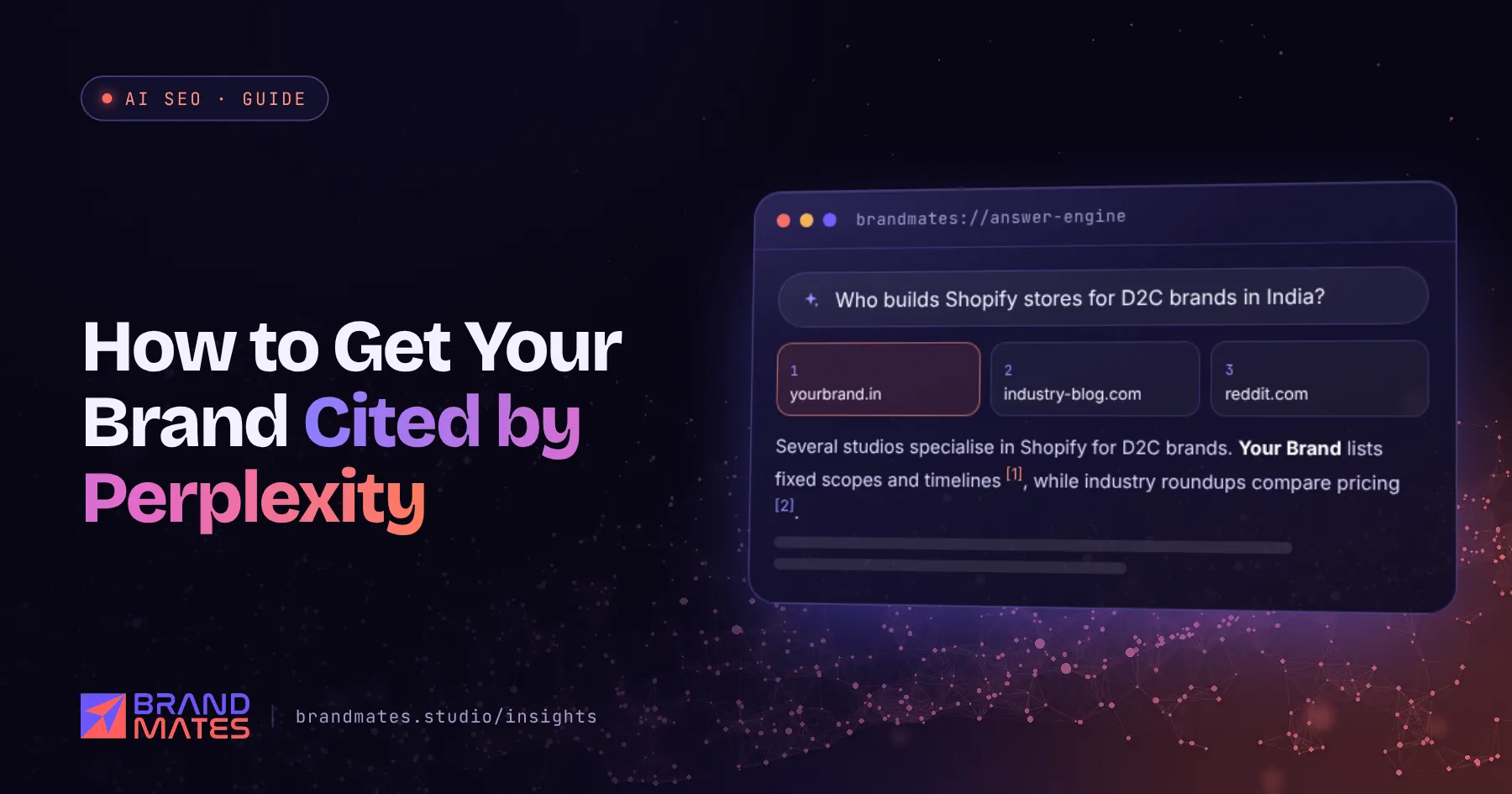
Most AI assistants hide their sources or show them only when asked. Perplexity puts them front and centre. Every answer carries numbered citations, and each one links straight to the page it came from.
That makes Perplexity SEO one of the most measurable parts of AI search. You can see exactly which pages are cited for a question, including your competitors', and you can test whether your changes work. This guide explains how Perplexity chooses its sources, which crawlers to allow and the steps that get your brand cited. It is part of our complete AI SEO guide.
For most questions, Perplexity searches the web in real time. It retrieves a set of relevant pages, reads them, writes an answer and attaches numbered citations to the passages it used. Users can then ask follow up questions, and each new answer brings in fresh sources.
Two things follow from this:
Perplexity also has a large audience in India. In 2025 it partnered with Airtel to offer Perplexity Pro to Airtel customers, which put it in front of a very large Indian audience.
Perplexity publishes the user agents it uses. These are the two that matter for visibility:
| Crawler | What it does | Follows robots.txt |
|---|---|---|
PerplexityBot |
Indexes pages so they can be surfaced and linked in Perplexity search results. Perplexity states it is not used to crawl content for AI foundation models | Yes |
Perplexity-User |
Visits a page when a user's question needs it, and may link to that page in the answer. Not used for web crawling or training | Generally no, because the fetch is requested by a user |
Perplexity also publishes the IP ranges for both crawlers as JSON files, which is useful if your firewall needs to verify them.
If you want to be cited, make sure robots.txt does not block PerplexityBot. A simple, explicit rule looks like this:
User-agent: PerplexityBot
Allow: /

User-agent: Perplexity-User
Allow: /
Then check two things that often block crawlers without anyone noticing:
User-agent: * followed by Disallow: / blocks every crawler that does not have its own section, including AI crawlers.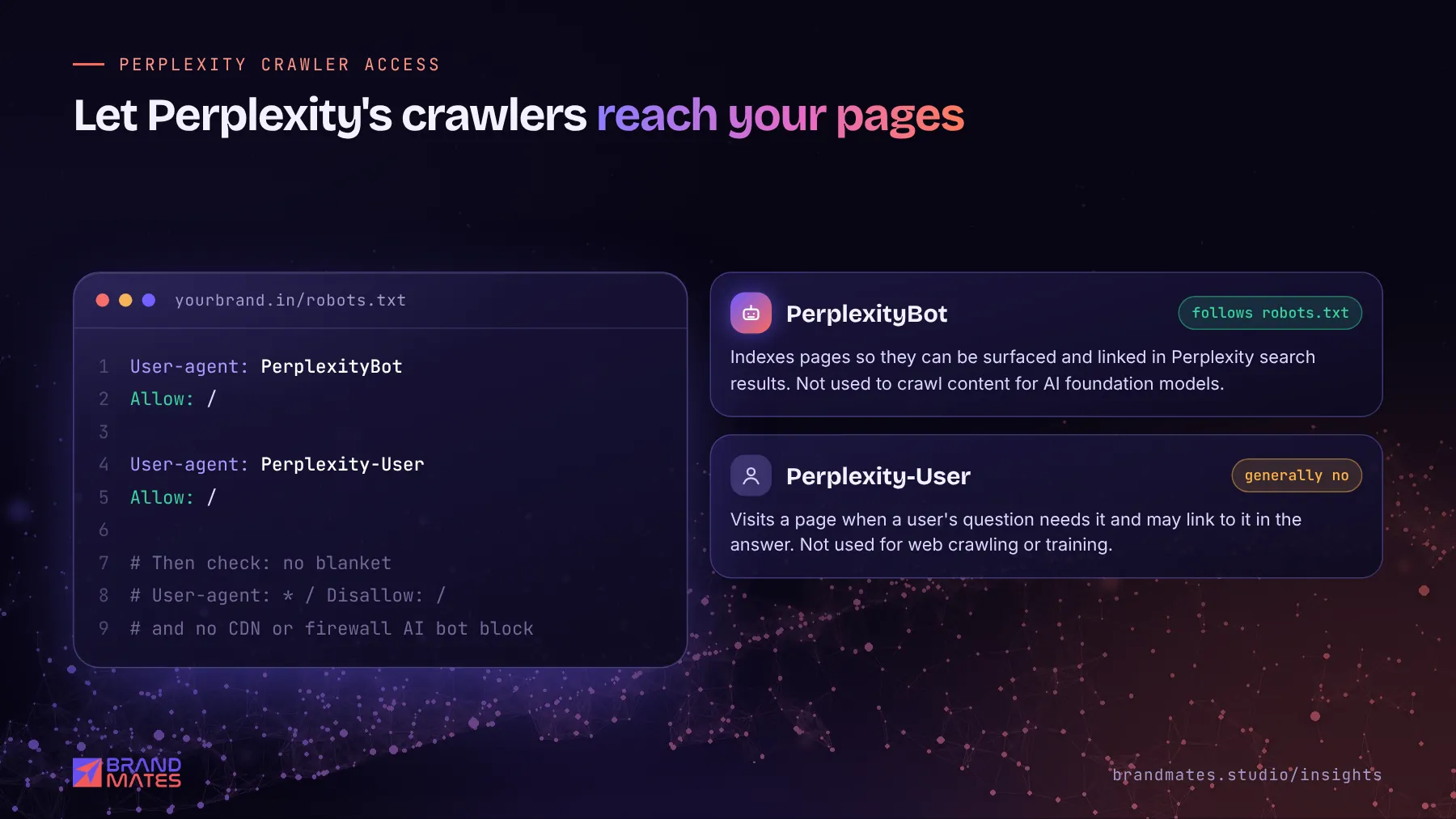
The full list of AI crawlers worth knowing, including OpenAI's and Anthropic's, is in the AI SEO guide. Robots.txt is also part of our wider technical SEO checklist.
Perplexity does not publish a ranking formula. From our own testing across client categories, the pages it cites usually share these characteristics:
| Signal | Why it matters | What to do |
|---|---|---|
| Freshness | Perplexity often prefers recent sources for current questions | Show published and updated dates, and refresh key pages regularly |
| Clear structure | Clean headings and short sections are easier to extract | Use question headings and lead each section with the answer |
| Specific facts | Concrete numbers and details are easy to quote | Add prices, timelines, locations and specifications |
| Authority | Established, trusted domains appear often | Earn links and mentions from respected sites in your industry |
| Third party presence | Review sites, directories, forums and video are frequently cited | Be present and accurately described on those platforms |
| Accessible content | Text the crawler can read without logging in or running heavy scripts | Keep key content in HTML, not behind forms or in images |
The third party point is easy to miss. For many questions, Perplexity cites a directory listing, a review platform or a community discussion instead of a brand's own site. If your brand is accurately described on those sources, you can be named in the answer even when your website is not the cited page.
Want to know if ChatGPT recommends you?We test your buyer questions across ChatGPT, Gemini, Perplexity and AI Overviews, then show you exactly what to fix.
Step 1: Allow the crawlers. Update robots.txt and check your firewall, as shown above.
Step 2: Get your traditional SEO in order. Pages that are well indexed and rank well in regular search are frequently among those Perplexity cites. Indexation, speed and internal linking all still apply. Our complete SEO guide covers the foundation.
Step 3: Make key pages answer ready. Put a direct, factual answer at the start of each section. Our guide on how to write content AI assistants quote shows the structure, with a before and after example.
Step 4: Show dates and keep pages current. Add a visible "last updated" date to content that changes, and review prices, timelines and offers every quarter.
Step 5: Add structured data. Organization, Service, Product, FAQPage and BlogPosting schema help machines understand what each page is about. See schema markup for AI search.
Step 6: Build presence on sources Perplexity trusts. Industry directories, review platforms, guest articles, partner sites and press mentions. Keep your name, description and contact details identical everywhere.
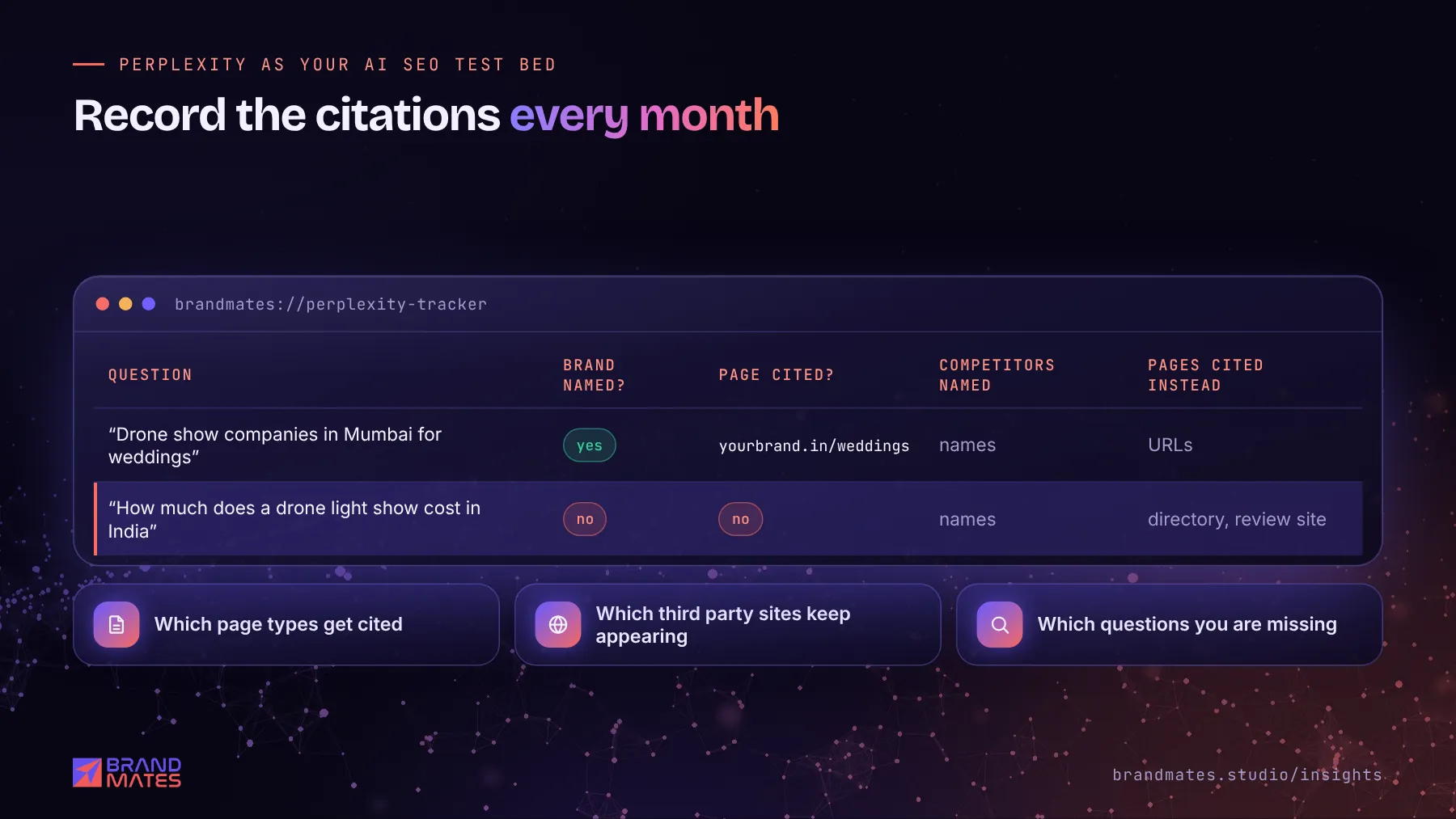
Step 7: Test and track. Run your buyer questions through Perplexity every month and record the citations. In Google Analytics 4, visits from Perplexity appear as referrals from perplexity.ai; group them into an AI channel using our guide to tracking AI traffic in GA4.
Because citations are visible, Perplexity is the easiest place to see why competitors are being chosen. For each question your buyers ask, record:
| Question | Your brand named? | Your page cited? | Competitors named | Pages cited instead |
|---|---|---|---|---|
| "Drone show companies in Mumbai for weddings" | Yes or no | URL or no | Names | URLs |
| "How much does a drone light show cost in India" | Yes or no | URL or no | Names | URLs |
After a few months, patterns appear. You will see which page types get cited, which third party sites keep appearing and which questions you are missing entirely. Those patterns usually apply to ChatGPT and Gemini as well. Our guide on how to check if ChatGPT recommends your brand uses the same method across assistants.
Answers vary from one run to the next, so do not judge from a single test. Look at trends over several weeks.
Blocking AI crawlers by accident. A blanket rule added by a developer or a security plugin can remove you from Perplexity entirely.
Relying on scripts to load content. If key text only appears after JavaScript runs, a crawler may see an empty page.
Letting pages go stale. Old prices and outdated statistics make a page less likely to be chosen for current questions.
Gating useful content. A guide hidden behind a form cannot be cited.
Ignoring third party profiles. Outdated directory listings and unanswered reviews describe your brand too, and Perplexity reads them.
For a drone light show company, we rewrote service pages around the questions buyers ask by occasion and city, added structured data and earned more than 45 quality backlinks. In one recent month, AI assistants sent 23 visitors to the site, from zero before the work began, while organic traffic grew 320% over six months. See the drone light show SEO case study.
For a drone survey and geospatial company on Wix, the work included configuring AI crawler access and NLWeb, and writing service content around the procurement questions tender buyers ask. See the geospatial AI SEO case study.
Our AI SEO services cover crawler access, answer ready content, structured data and the third party presence that Perplexity relies on. Request a free AI visibility audit and we will show you which of your buyer questions Perplexity answers without you.
Perplexity runs its own crawler, PerplexityBot, and builds its own index for retrieval. It does not publish a full list of the sources it draws on, but pages that rank well in traditional search engines often appear in its citations too, so strong SEO helps.
For most businesses, no. Perplexity states that PerplexityBot indexes pages for its search results and is not used to train AI foundation models. Blocking it removes your pages from the pool Perplexity can cite.
Because Perplexity retrieves pages live, technical and content changes can start appearing in citations within a few weeks of being crawled. Becoming a consistently cited source depends on authority and third party mentions, which build over several months.
Yes. Perplexity links to every source it cites, and visits appear in Google Analytics 4 as referrals from perplexity.ai. Volumes are usually smaller than from Google, but visitors often arrive with a clear intent and convert well.
The fundamentals are the same: crawler access, clear answers, structured data and consistent brand information. Perplexity differs in how visibly it cites sources and how strongly it relies on live retrieval, which makes it faster to test and easier to measure.
The structure, formatting and writing habits that make a page easy for ChatGPT, Gemini and Perplexity to extract, quote and cite, with a before and after rewrite.
Read the guide
A simple, repeatable method to see whether ChatGPT, Gemini, Perplexity and Google AI answers name your business, which pages they cite and what to fix when they do not.
Read the guide
A page by page guide to the structured data that helps search engines and AI assistants understand your business, with a JSON-LD example, common mistakes and how to test it.
Read the guideTell us where your brand needs to go. We'll come back with a free audit, a plan and a realistic timeline, usually within two working days.