On Page SEO Checklist: 20 Things to Fix on Every Page
Twenty specific checks to run on every service page, product page and article, from title tags and headings to internal links, images and structured data.
Read the guideHow to find the searches your buyers actually make, sort them by intent, map each one to the right page and decide what to target first.
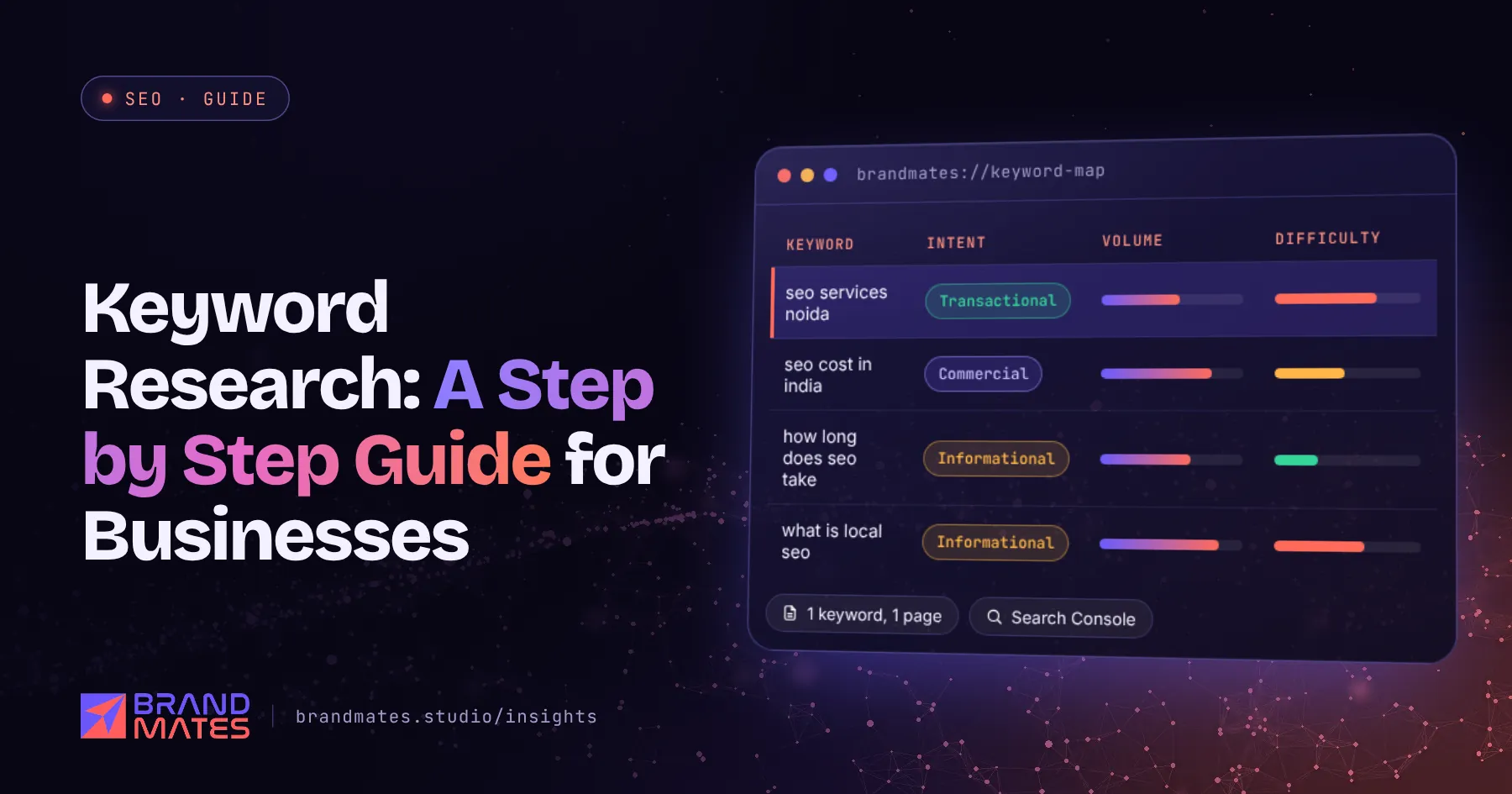
Most websites are written around what the business wants to say. The sites that rank are written around what buyers actually type into Google.
Keyword research is how you close that gap. It tells you which searches your customers make, what they expect to find, how competitive each search is and which page on your site should answer it. This guide walks through the process we use with every client, step by step, with free and paid tools. It is part of our complete SEO guide for businesses.
The goal is not a long spreadsheet of high volume words. The goal is a plan that answers three questions:
When those three questions are answered, content, on page work and link building all have a direction.
Before opening any tool, write down:
Talk to your sales or support team. The questions they hear every week are often the keywords competitors have missed.
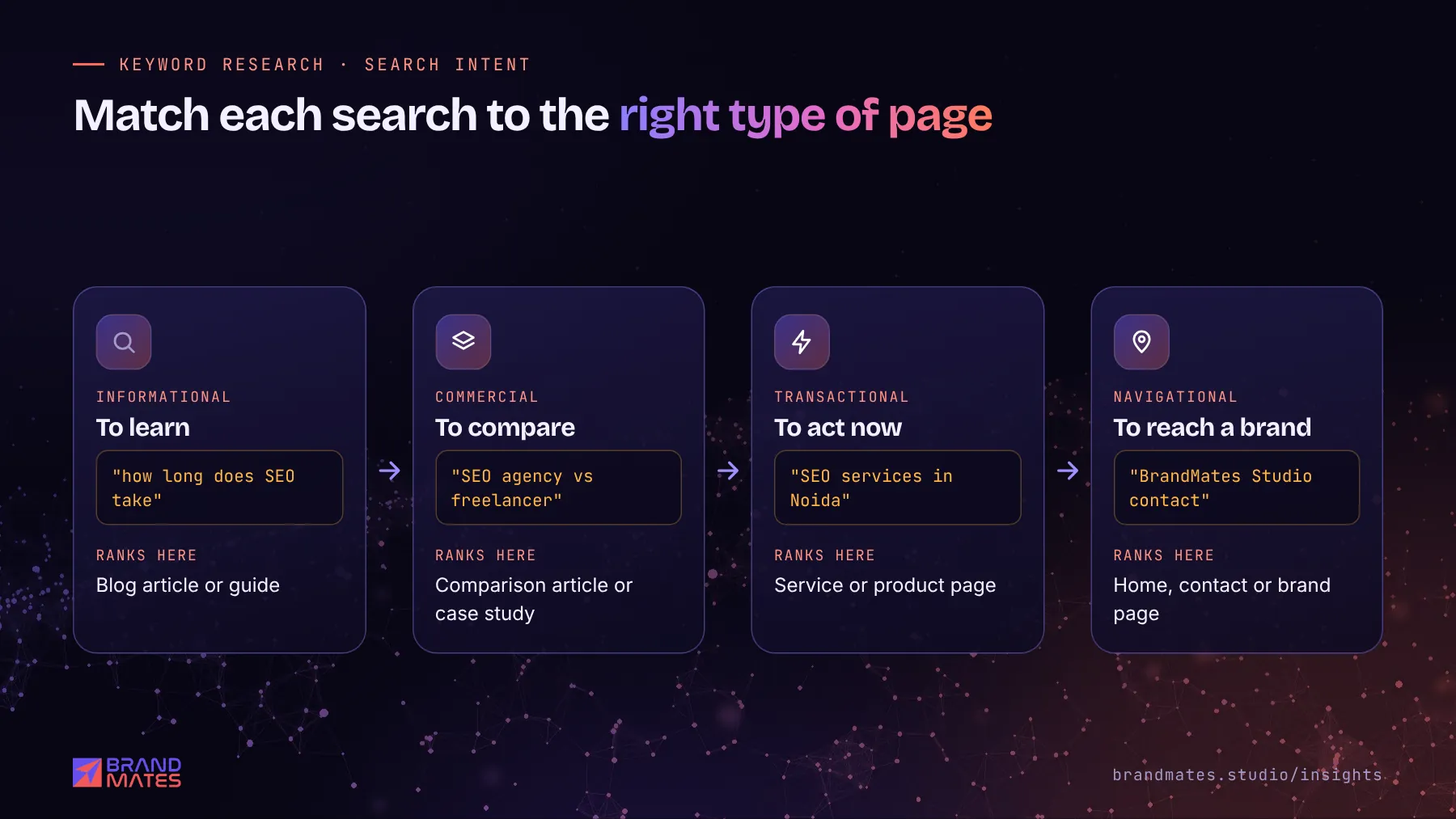
Every search has an intent behind it. Matching that intent matters more than matching exact words.
| Intent | What the searcher wants | Example | Page that should rank |
|---|---|---|---|
| Informational | To learn or understand | how long does SEO take | Blog article or guide |
| Commercial | To compare options before choosing | SEO agency vs freelancer | Comparison article, case study |
| Transactional | To buy, book or enquire now | SEO services in Noida | Service or product page |
| Navigational | To reach a specific brand or page | BrandMates Studio contact | Home, contact or brand page |
The quickest way to check intent is to search the keyword yourself and look at what ranks. If the first page is full of blog guides, a service page will struggle to rank there, however well it is optimised.
Use several sources, because each shows a different slice of demand.
| Tool | Cost | What it is good for |
|---|---|---|
| Google Search Console | Free | Searches you already appear for, with impressions and clicks |
| Google Keyword Planner | Free with a Google Ads account | Search volume ranges and related keyword ideas |
| Google autocomplete | Free | How people actually phrase searches as they type |
| People Also Ask | Free | Real questions related to your topic |
| Ahrefs or Semrush | Paid | Competitor keywords, difficulty scores, volume estimates |
Search Console is the most underused of these. Open the Performance report, set the date range to the last three months, and sort by impressions. You will find searches where Google already shows your site but you rarely get clicked. Those are often the fastest wins.
Competitor research in Ahrefs or Semrush shows which keywords bring traffic to the sites that outrank you. Filter for keywords where they rank and you do not.
Autocomplete and People Also Ask show the long tail: specific, lower volume phrases that are easier to rank for and often closer to a buying decision.
Search volume and difficulty scores are estimates. Different tools give different numbers for the same keyword. Use them to compare keywords against each other, not as exact figures.
A few practical rules:
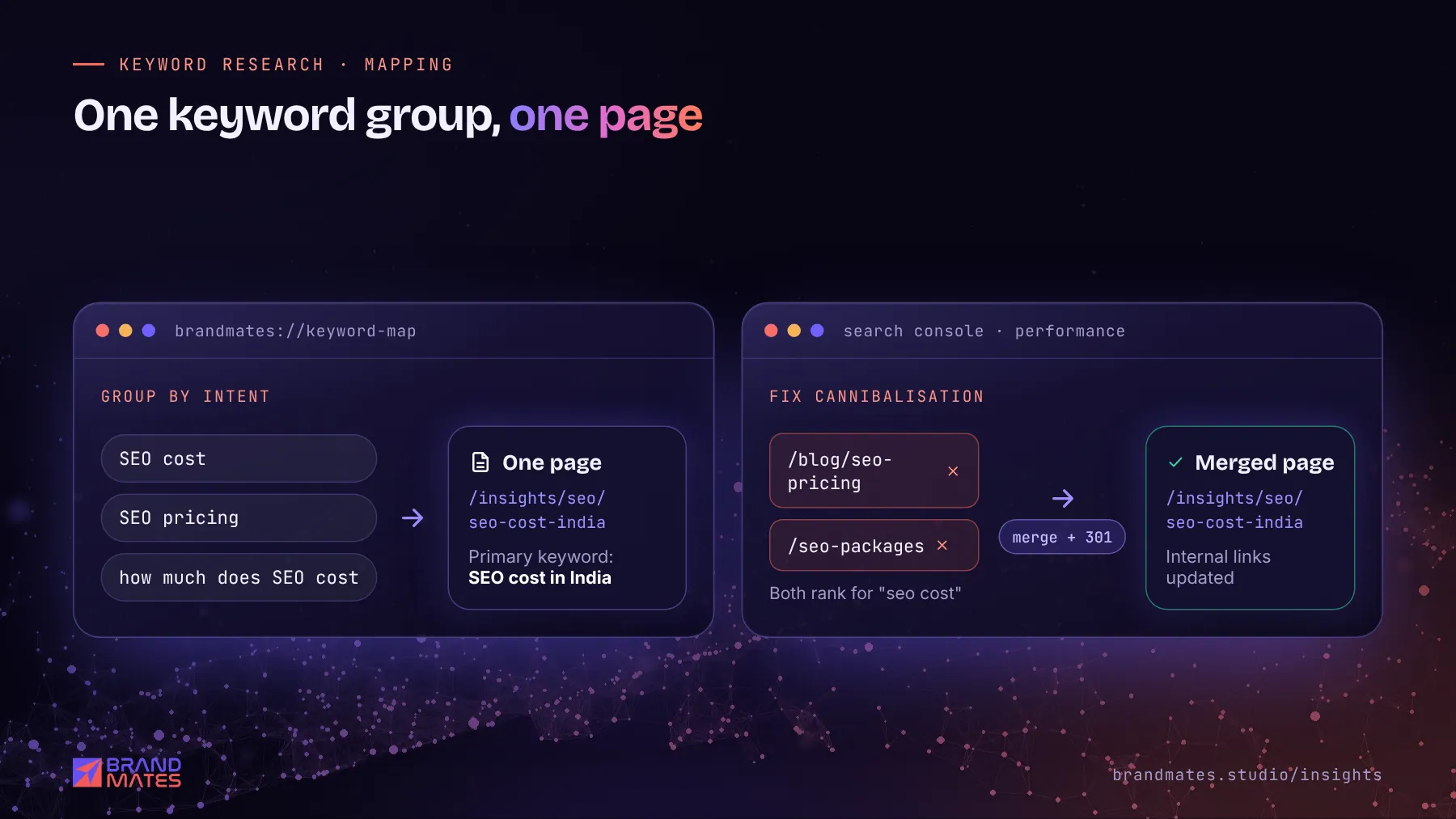
Many keywords mean the same thing. "SEO cost", "SEO pricing" and "how much does SEO cost" should be answered by one page, not three.
Group keywords that share the same intent and would be satisfied by the same page. Each group becomes one page, with a primary keyword and several secondary ones.
Groups then roll up into topic clusters: a central guide covering a broad subject, with supporting articles each answering one specific question. That is exactly how this library is built, and it helps search engines understand the depth of your expertise.
Not sure what is holding your site back?We check technical health, content, competitors and AI visibility, then send a prioritised fix list within two working days.
This is the step most businesses skip, and it causes most keyword problems.
| Keyword group | Primary keyword | Intent | Target page | Status |
|---|---|---|---|---|
| SEO services | SEO services in Noida | Transactional | /services | Exists, needs rewrite |
| SEO pricing | SEO cost in India | Commercial | /insights/seo/seo-cost-india | New article |
| SEO timeline | how long does SEO take | Informational | /insights/seo/how-long-does-seo-take | New article |
| SEO audit | SEO audit checklist | Informational | /insights/seo/seo-audit-checklist | New article |
Keep this map in a shared spreadsheet. Before anyone writes a new page, check the map to see whether an existing page should be improved instead.
Keyword cannibalisation happens when several pages on your site target the same search. Google has to choose between them, often switches between them, and none of them ranks as well as one strong page would.
Signs of cannibalisation in Search Console:
The fix is usually to merge the weaker pages into the strongest one, redirect the old URLs and update internal links.
You cannot target everything at once. Score each keyword group on three things:
Start with high value groups where you already rank on page two, or where competition is weak. Optimise existing pages first, using our on page SEO checklist, then create new pages for the gaps.
For a drone light show company, we researched keywords by occasion (weddings, corporate events, festivals) and by city, instead of chasing the broad term "drone show". Each occasion and city combination got a clear target page. Combined with rewritten service pages, event content and more than 45 quality backlinks, organic traffic grew 320%, top 10 rankings grew 185% and enquiries grew 210% over six months. See the drone light show SEO case study.
AI assistants like ChatGPT and Perplexity do not work on exact keywords. Buyers ask them longer, conversational questions. The good news is that keyword research already captures most of these questions through People Also Ask and long tail searches.
Write pages that answer those questions directly and clearly, and they serve both Google and AI assistants. Our guide on how to write content that AI assistants quote explains the format.
Keyword research is the first stage of every engagement in our SEO services, followed by mapping, page optimisation and content. If you want to see what your buyers search and where your site stands, request a free SEO audit and we will include the top keyword opportunities for your site. If you want to understand how quickly new keywords can rank, read how long SEO takes.
Start with Google Search Console to see searches you already appear for, then use Google Keyword Planner for volume ranges, and autocomplete and People Also Ask for real phrasing and questions. Together they cover most of what a small business needs.
One primary keyword plus a group of closely related secondary keywords that share the same intent. If two keywords need different answers, they need different pages.
A long tail keyword is a longer, more specific search, such as "drone light show for a wedding in Jaipur" rather than "drone show". Each has lower volume, but together they make up a large share of searches, and they are usually easier to rank for and closer to a decision.
Review your keyword map every three to six months, and whenever you launch a new service, product or location. Search Console data will show new queries appearing as your site grows.
It is when several pages on the same site target the same keyword and compete with each other in search results. Merging them into one stronger page and redirecting the others usually fixes it.
Twenty specific checks to run on every service page, product page and article, from title tags and headings to internal links, images and structured data.
Read the guide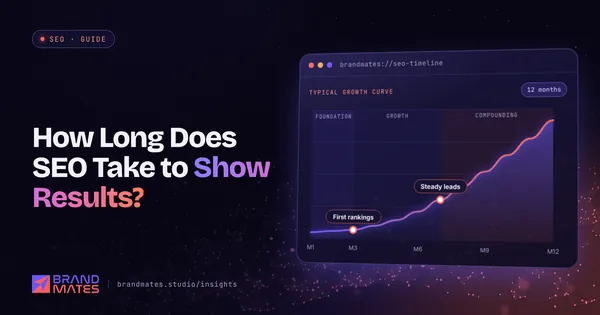
A realistic month by month SEO timeline, the six factors that decide how fast results arrive, and the early signals that show it is working.
Read the guide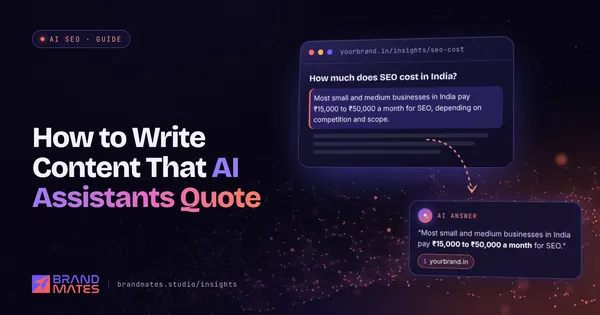
The structure, formatting and writing habits that make a page easy for ChatGPT, Gemini and Perplexity to extract, quote and cite, with a before and after rewrite.
Read the guideTell us where your brand needs to go. We'll come back with a free audit, a plan and a realistic timeline, usually within two working days.